
GuideHigher Level Creations
What is fulgurite
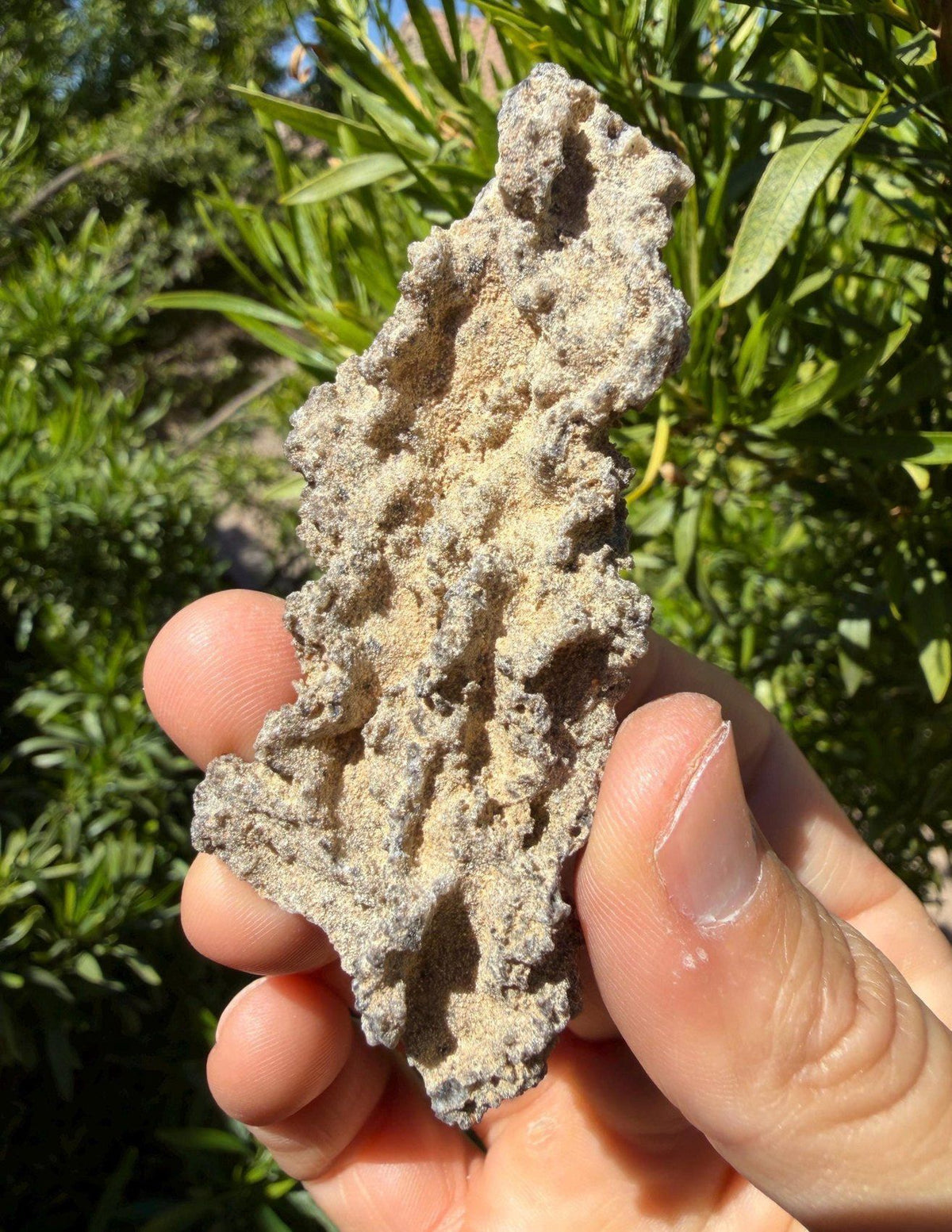
Fulgurite is what is left in the ground when lightning strikes sand. The bolt melts the silica along its own path and the melt cools into a hollow glass tube, a cast of the lightning itself. Peak temperatures inside a lightning channel exceed 30,000 K (Wikipedia, Fulgurite), so the whole thing happens in a fraction of a second. Every fulgurite in our Fulgurite collection is one of these casts.
How does fulgurite form?
Fulgurite forms when a lightning strike delivers more than 100 million volts of potential difference into ground that contains silica, "rapidly vaporizing and melting resistant materials" (Wikipedia, Fulgurite). The sand along the channel melts, the surrounding sand does not, and when the melt cools it is a glass tube with a smooth interior and a crust of fused grains on the outside.
The numbers are hard to picture. Kuo and colleagues, writing in Scientific Reports in 2021, measured the aftermath in rock fulgurites: "Cloud-to-ground lightning can cause shockwave pressures in excess of 10 GPa and temperatures above 1700 °C" (Kuo et al., 2021). They found feldspar grains still holding residual stresses of 1.57 GPa, several times what the untouched reference rock carried. The strike is over in an instant; the rock remembers it.
A fulgurite is the only natural object that is a direct cast of a lightning bolt. Meteorites record an impact and tektites record a flight, but a fulgurite is the shape of the electricity itself, branch for branch, at the moment it entered the ground.
What kinds of fulgurite are there?
Wikipedia classifies fulgurites into five types (Wikipedia, Fulgurite):
- Type I, sand fulgurites, the classic hollow tubes. This is what we sell.
- Type II, soil fulgurites, formed in mixed sediments.
- Type III, caliche fulgurites, in calcium rich sediments.
- Type IV, rock fulgurites, glassy crusts and veins on struck rock.
- Type V, droplet fulgurites, glass that was thrown clear of the strike.
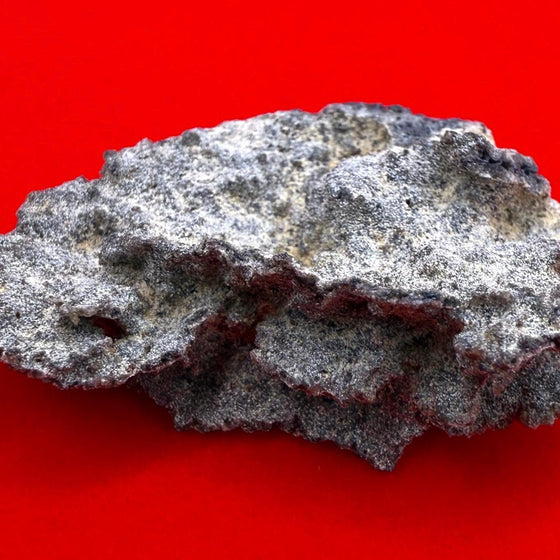
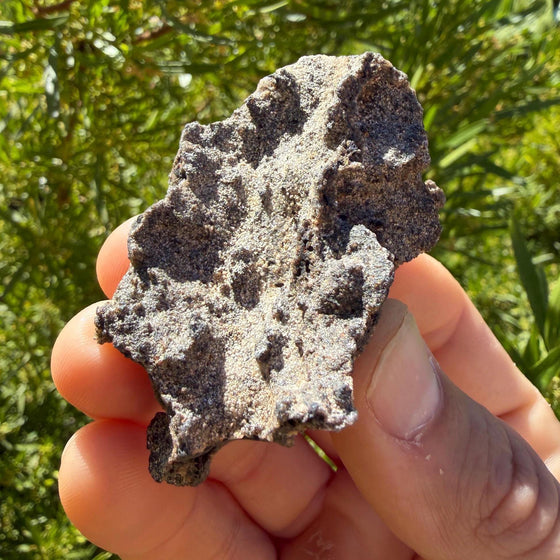
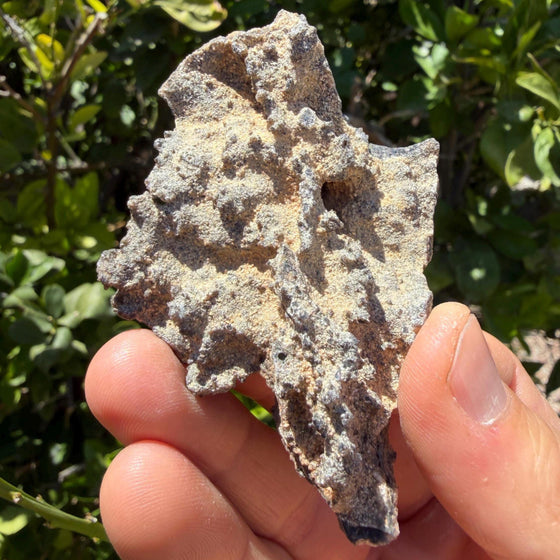
Sand fulgurites are the ones collectors know. Their color follows the sand they formed in, and the desert pieces we carry run from pale tan to gray.
How big can a fulgurite get?
Bigger than most people expect. Fulgurites "can exceed 20 centimeters in diameter and can penetrate deep into the subsoil, sometimes occurring as far as 15 m (49 ft) below the surface" (Wikipedia, Fulgurite). A specimen recovered in northern Florida measured a little over 4.9 m. The Yale Peabody Museum displays one of the longest preserved, about 4 m. A historical record from Cumberland in England describes one reaching 9.1 m.
The pieces you can buy are a different scale, because a fulgurite is hollow and brittle and breaks as it is dug. A hand sized branching tube is a good specimen. Each of ours is listed with its weight to the hundredth of a gram and its length in inches, and the photograph is of the exact piece.
Where is fulgurite found?
Anywhere lightning meets sand, which in practice means deserts, dunes and beaches. Wikipedia names finds from the Sahara Desert, from Winans Lake in Michigan and from Florida (Wikipedia, Fulgurite). The Sahara is the source of the fulgurite we sell, and the reason is simple: enormous areas of clean silica sand, thunderstorms, and dry conditions that preserve the glass afterward.
Scientists want them for a reason that has nothing to do with collecting. Fulgurites let researchers "estimate the frequency of lightning over a period of time, which can help to understand past regional climates" (Wikipedia, Fulgurite). A desert full of fulgurites is a record of storms that fell before anyone was there to see them.
How do you tell fulgurite from other glass?
Three things, none of which need a lab:
- It is hollow. A sand fulgurite is a tube. Look down the end and you see a smooth or bubbled channel.
- The outside is sand. The skin is rough with fused grains; the inside is glassy. Slag and industrial glass are glassy all the way through.
- It branches. Lightning forks, and so does the cast. A straight uniform tube is more likely a factory product.
Will's rule for every piece in the shop applies here too: the science first, then the metaphysical. The science of a fulgurite is a lightning strike frozen in glass. What it means to you after that is yours to decide.
How should you handle a fulgurite?
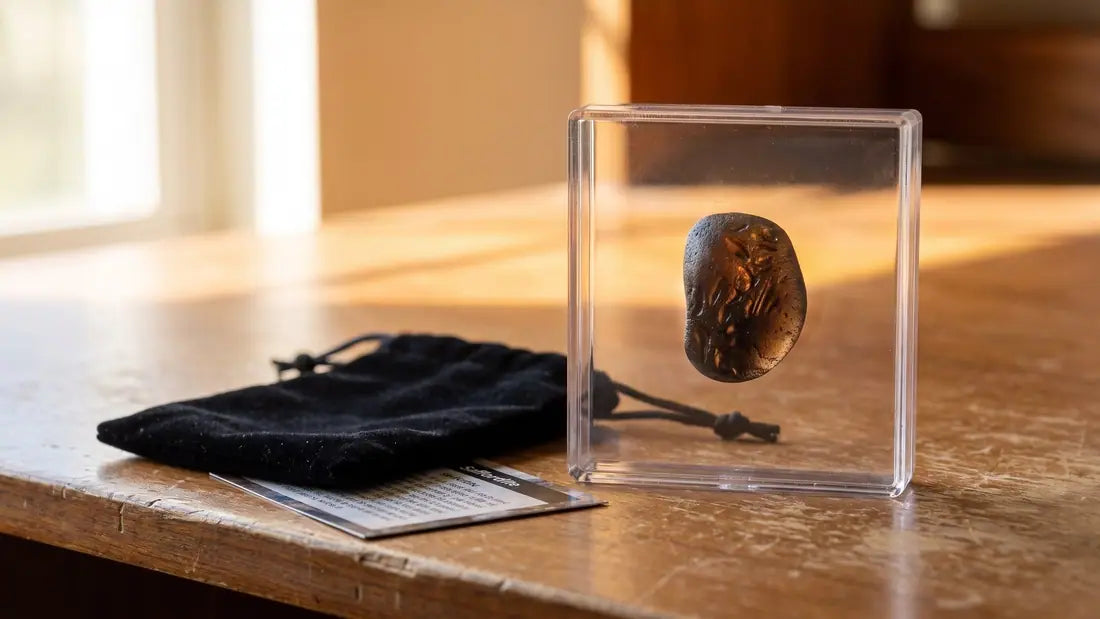
Gently. A fulgurite is a thin hollow tube of glass with a crust of loose sand, and it does not survive a pocket. This is why our fulgurites ship in a display case with a velvet carrying bag, as the listings say, and why the case is worth keeping it in.
Every piece is in the Fulgurite collection, alongside the other terrestrial pieces in Earth Specimens.
Frequently asked questions
Is fulgurite a meteorite?
No. Fulgurite is Earth sand fused by a lightning strike, with no connection to space (Wikipedia, Fulgurite). It belongs with our Earth specimens, not with the meteorites.
How hot is the lightning that makes it?
Peak temperatures inside a lightning channel exceed 30,000 K (Wikipedia, Fulgurite), and the rock around a strike records temperatures above 1,700 C and pressures over 10 GPa (Kuo et al., 2021).
Why is fulgurite so fragile?
Because it is a hollow glass tube, often only millimeters thick, with a skin of loosely fused sand. Even large finds, like the 4.9 m Florida specimen, have to be excavated in sections (Wikipedia, Fulgurite).
How do I know yours is real?
Each piece is hollow, branching and sand skinned, listed with its weight and length and photographed as it is. Will has been in this trade for eight years and buys from people he has known for years and at the shows in Tucson.
What arrives with a fulgurite?
A display case and a velvet carrying bag, because the piece needs them. Orders leave within one day, United States shipping is free over 75 dollars, and there is a 30 day return policy.
The short version
Fulgurite is lightning cast in glass: a hollow, branching, sand skinned tube made in a fraction of a second at temperatures no furnace reaches. It is fragile, it is a record of ancient weather, and each one is the shape of a single bolt. See the current pieces in the Fulgurite collection.
Shop 7 fulgurites